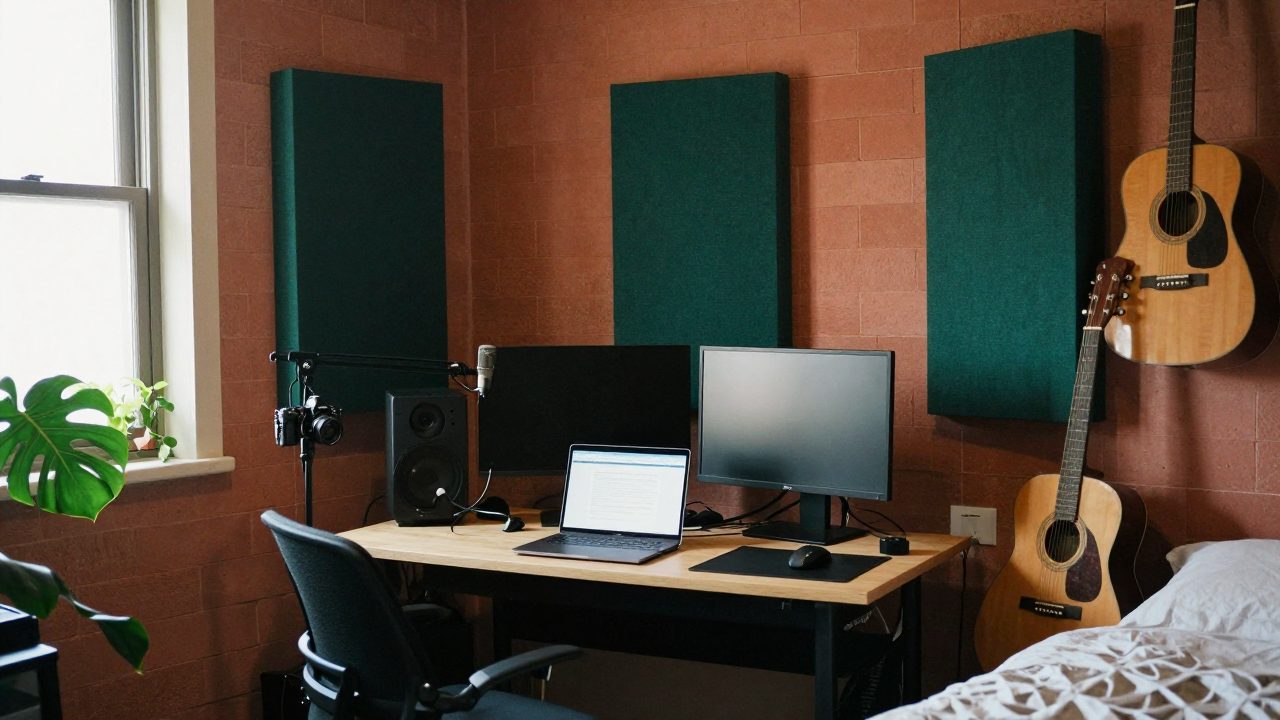
More music is made at home than ever before. A computer, an audio interface and a microphone are enough to record ideas, and sometimes whole songs. So what is a studio still for? The honest answer: for certain stages only, and that is perfectly fine.
What a home studio does very well
- Writing and demoing, the moment the idea arrives, without watching the clock.
- Producing electronic parts: synthesisers, drum machines and virtual instruments do not depend on room acoustics.
- Recording DI guitar or bass through an amp simulator.
- Experimenting: trying ten arrangements, taking your time, getting it wrong without pressure.
Where the room makes the difference
As soon as a microphone picks up the air in the room, acoustics become part of the recording. In a bedroom, bare parallel walls create resonances and a short echo that make a voice sound "small" or metallic. No mixing process really removes it.
Lead vocals are the most common case: they sit at the front of the mix and every flaw is audible. Acoustic drums need space, several microphones and a room that sounds good, not to mention the neighbours. A live band needs isolation that few flats can provide.
Monitoring, the other difference
You mix what you hear. In an untreated room, some low frequencies are boosted or disappear depending on where you sit: you end up fixing problems that do not exist and missing others. That is why a mix made at home often sounds very different in a car. A treated, measured control room gives reliable monitoring, so decisions can be made quickly.
Comparing costs
A decent home studio means an upfront investment (audio interface, microphone, headphones, monitors, acoustic treatment) and then time spent learning. A professional studio is paid for by use: you only pay for the hours you need, with an engineer. For a one-off project, the studio often costs less than people expect; for daily production, a home studio quickly becomes essential.
The hybrid method
Most of our clients combine the two:
- Writing and demos at home.
- At the studio: drums, lead vocals, acoustic instruments, sometimes the band live.
- Back home for electronic overdubs and extra ideas.
- Mixing and mastering at the studio, for reliable monitoring and a fresh pair of ears.
For this to work, keep the same sample rate (48 kHz, for example) in both places, export audio tracks aligned from the start of the song and name them clearly. Software projects and plug-ins are not always compatible; audio tracks are.
Improving your home studio on a budget
- Record vocals in the most furnished room, facing a bookcase or hanging clothes rather than a bare wall.
- Place your speakers in a triangle with your head, away from the walls, and always check on headphones.
- Regularly compare your work with reference tracks at the same volume.
- Start with a good dynamic microphone: it picks up less of the room than a condenser.
Our audio lessons can be devoted entirely to your home studio: bring photos of your room and a project, and we will start from the concrete problems you face.